Sunday Night, 9:15: A New York Soprano in Your Living Room
On Sunday night, November 14, 1926, Washington station WRC joined New York stations to broadcast soprano Frieda Hempel and the young violinist Toscha Seidel. It was a concert with no ticket and no need to dress up.
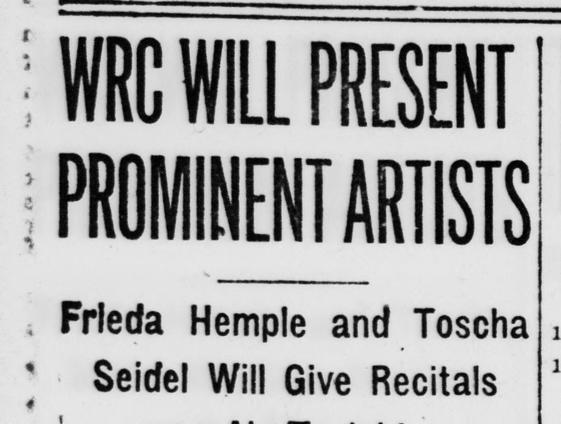
The lead story on the radio page that day was "WRC Will Present Prominent Artists." From 9:15 to 10:15 p.m., the famous soprano Frieda Hempel gave a recital, with a pianist, a flutist and the Atwater Kent Orchestra. Then the young Russian violinist Toscha Seidel played Dvořák's "Slavonic Dance No. 2," Kreisler's "Tambourin Chinois" and Beethoven's "Turkish March."
The radio was busy all day. At 11 a.m. came the service from Calvary Baptist Church, and at 4 p.m. the service at Bethlehem Chapel of Washington Cathedral. At 7:20 p.m. the Sunday night program came in from the Capitol Theater in New York. On the same page, the long-distance listings began at 9 a.m. with a New York "children's program: comic stories and music."
A concert you didn't have to dress up for
For people 100 years ago, this was a small miracle. To hear a famous soprano, you used to buy a ticket, put on your good clothes and go to the theater. Now you could finish dinner, sit in your own chair and turn a dial. The paper even listed each station's wavelength and distance. Pulling in Cincinnati, Boston or Pittsburgh was something to brag about.
The page 42 radio page
- 9:15–10:15 p.m.: soprano Frieda Hempel (WRC with WEAF and WJZ)
- Then: violinist Toscha Seidel with the Maxwell Ensemble
- Pieces: Dvořák "Slavonic Dance No. 2," Kreisler, Beethoven "Turkish March"
- 11 a.m.: Calvary Baptist Church service
- 4 p.m.: Bethlehem Chapel, Washington Cathedral
- 7:20 p.m.: Sunday night program from the Capitol Theater, New York
100 years later
Today one phone can play music from any concert hall in the world. It started with Sunday nights like this one in 1926: a family gathered around the radio, holding its breath for the soprano's high note. The technology changed. The joy of listening together did not.
Sources
Dollar conversions use the U.S. Bureau of Labor Statistics CPI-U (1926 annual average 17.7; September 2026: 336.94), a factor of about 19.