Not "Cabin" John but "Captain" John: Old Land Papers Reveal Whose Name It Really Was
On Sunday morning, November 14, 1926, the paper carried a surprise. "Cabin John," the name everyone used for the creek and neighborhood at the end of a Washington carline, was a mistake. The real name, the government found, belonged to a prominent Native American who lived in the valley: Captain John.
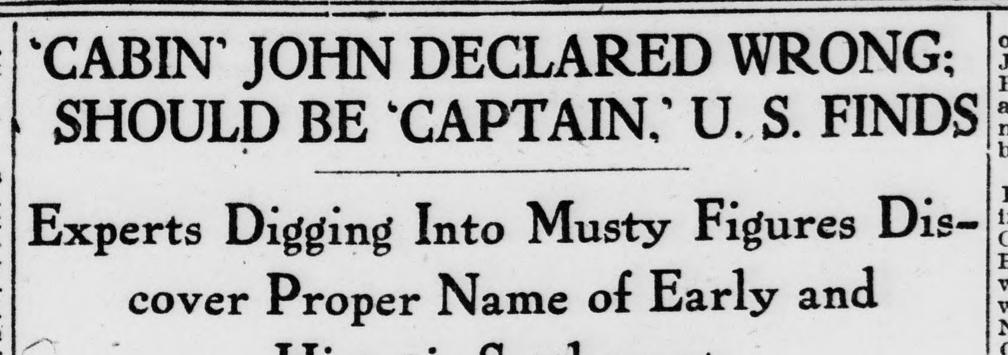
Page 54 of the Sunday Star put it plainly: "'Cabin' John Declared Wrong; Should Be 'Captain,' U. S. Finds." It was about the creek and the neighborhood in nearby Maryland, out at the end of the streetcar line, that everyone called "Cabin John." Most people probably pictured some fellow named John living in a little cabin.
But while sorting out land titles, the Department of Justice went digging through old, musty records, and found something else. The earliest name on the papers was "Captain John's Run," the stream that flows under the bridge carrying Washington's water supply and into the Potomac. "Capt. John," the paper reported, "was an Indian of prominence, who lived in the valley through which the stream flows." In today's words, a prominent Native American.
If there had been a prize for land names
While it was at it, the department listed the old land grants along the Potomac, in order. That list is the hidden treasure of the story. "Billingsgate," "St. Philip and Jacob" and "Whitehaven" sound respectable enough. But tucked between them are "Bully's Disappointment" and "Arrel's Folly." More than 200 years earlier, somebody got a piece of land and was disappointed, and somebody else named his own land a folly. We will never know why, but the names alone make you smile.
The old papers described the valley simply as "a deep valley." No cabin, no John in a cabin. Over the years, passed from mouth to mouth, "Captain" quietly slid into "Cabin." Say them both out loud and you can hear how it happened.
The page 54 story
- Found by: the U.S. Department of Justice, during a land title inquiry
- Original name: "Captain John's Run"
- Captain John: a prominent Native American who lived in the valley
- The stream: flows under the Washington water supply bridge into the Potomac
- Old land grants: Bully's Disappointment, Billingsgate, Arrel's Folly, St. Philip and Jacob, Whitehaven
100 years later
Funnily enough, the place is still called Cabin John today, and people still tell different stories about where the name came from. But the 1926 search reminded everyone of something worth remembering: behind a name we say every day, there may be the story of someone who lived on that land first. The great stone bridge over the creek, built in 1863, was once the longest stone arch in the world, and it is today's puzzle photo.
Sources
- Sunday Star, Nov. 14, 1926, page 54: "'Cabin' John Declared Wrong; Should Be 'Captain,' U. S. Finds"
- Library of Congress: Cabin John Bridge, "The largest stone arch in the world" (postcard, 1880s–1890s)
Dollar conversions use the U.S. Bureau of Labor Statistics CPI-U (1926 annual average 17.7; September 2026: 336.94), a factor of about 19.