The 95 Pairs of Shoes Left by a Man Who Walked the World for 40 Years
On November 12, 1926, the paper reported that the travel writer Frank G. Carpenter's collection of 95 pairs of shoes from around the world was going to the Smithsonian. His daughter gave her father's shoes to the public.
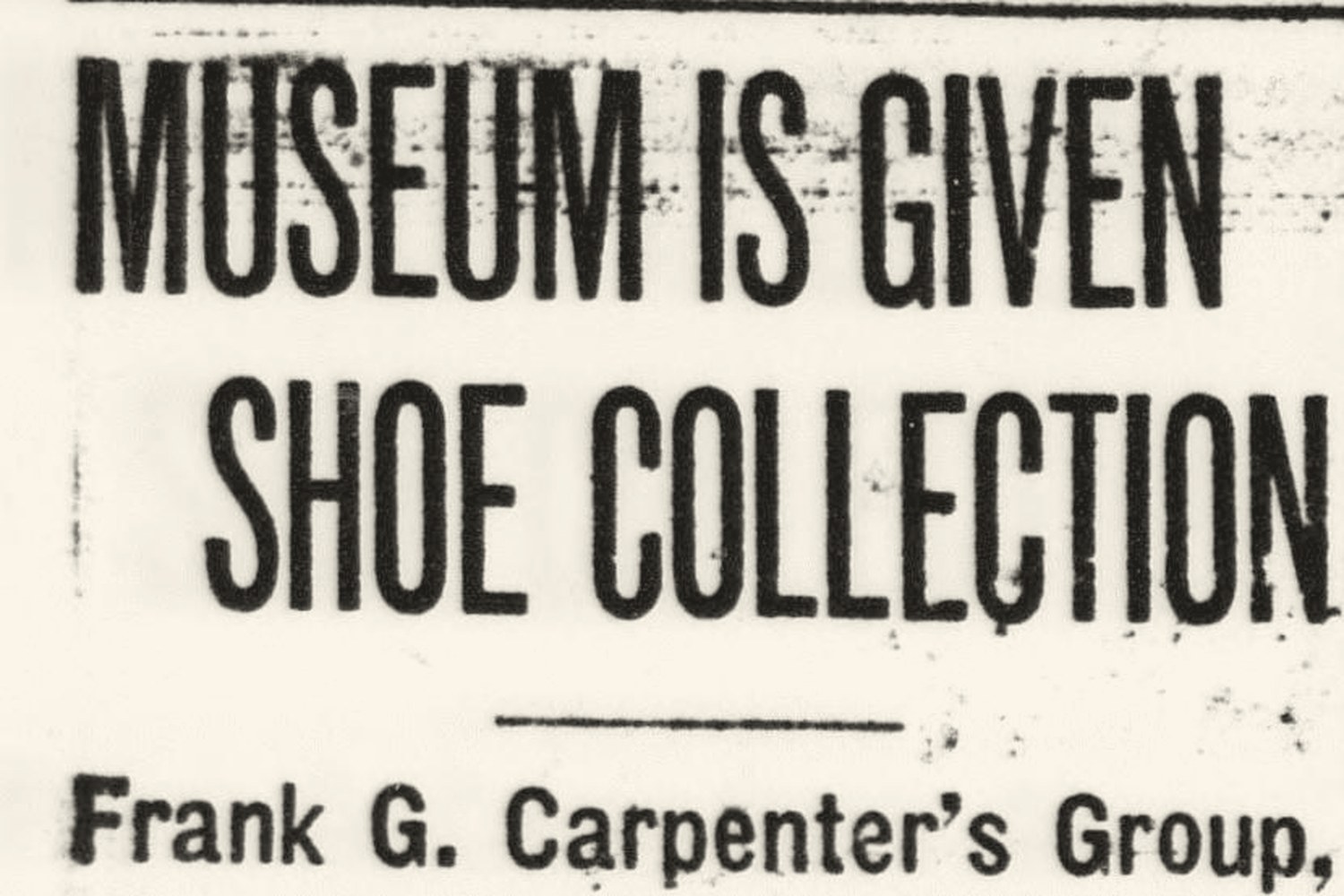
Page 22 of the Evening Star that day carried a Washington story. A collection of the footwear of many nations, made by the late Frank G. Carpenter during 40 years of wandering about the earth, had been presented to the Smithsonian Institution by his daughter, Mrs. W. C. Huntington. There were 95 pairs, to be placed on exhibition at the National Museum.
It included curiosities: the clogs of a Hindu priest-pilgrim from the Ganges, the leather temple slippers of a worshiper at Santa Sophia mosque in Constantinople, and the woven linden-bark sandals of a Russian peasant.
Clogs shaped like a flying dolphin
The Hindu priest's clogs were flat slabs of wood shaped like a flying dolphin with its tail thrown back, raised from the ground by two sets of stilts and ornately carved. Their most curious feature was how they stayed on: a single wooden knob that fit between the toes. In the same day's paper, a store advertised boys' and girls' shoes for $1.98 a pair. People everywhere walked their own roads in their own kinds of shoes.
On page 22
- Collector: travel writer Frank G. Carpenter (died 1924)
- Years: 40 years of travel
- Size: 95 pairs
- Given by: his daughter, Mrs. W. C. Huntington → Smithsonian
- Highlights: a Hindu priest's clogs, Santa Sophia temple slippers, a Russian peasant's bark sandals
100 years later
Carpenter left more than shoes. The thousands of photographs he gathered on his travels also reached the Library of Congress through his daughter Frances, and anyone can still see them. A family chose not to keep a lifetime's collection to itself — and so, a century later, we can still walk that road with him.
Sources
- Evening Star, Nov. 12, 1926, page 22: "Museum Is Given Shoe Collection"
- Wikipedia: Frank G. Carpenter (travel writer, 1855–1924)
Dollar conversions use the U.S. Bureau of Labor Statistics CPI-U (1926 annual average 17.7; September 2026: 336.94), a factor of about 19.