Shaw Wins the Nobel: "It Must Be Because I Wrote Nothing That Year"
On November 12, 1926, the paper reported that George Bernard Shaw would receive the 1925 Nobel Prize for literature. Shaw laughed that it must be because he wrote nothing that year. A few days later he decided to spend the money on others.
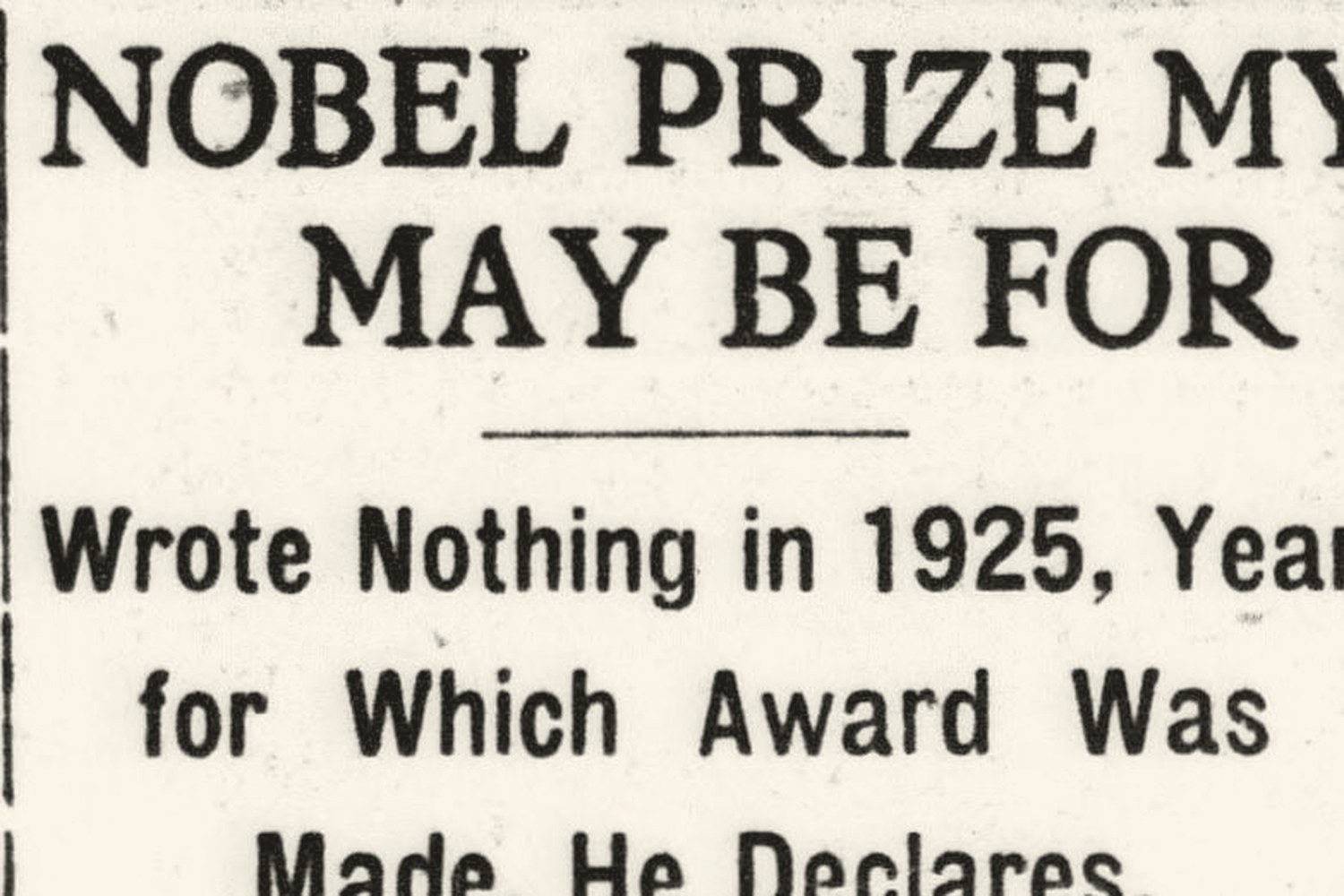
Page 16 of the Evening Star that day carried an AP story from London. Stockholm had announced that the Irish-born playwright George Bernard Shaw had been chosen for the Nobel Prize for literature for 1925 — a prize held over a year because no winner was named at the time.
Shaw himself seemed puzzled. "It is a great mystery to me," he said, and added laughingly that he supposed it was awarded to him because he wrote nothing at all that year. The headline took up the joke: the prize, it said, "may be for silence." Shaw had turned seventy only a few months before.
The other prizes that day
The same page carried more Nobel news. The 1925 chemistry prize went to Richard Zsigmondy of the University of Göttingen, known for his work on gold; the 1926 prize to Theodor Svedberg of Uppsala. The 1925 physics prize was divided between James Franck and Gustav Hertz, and the 1926 physics prize went to Jean Baptiste Perrin of the Sorbonne.
On page 16
- Winner: George Bernard Shaw, 1925 Nobel Prize in Literature
- Announced: a year late, in November 1926
- Shaw's line: it must be because he wrote nothing
- Chemistry: Zsigmondy (1925, gold colloids), Svedberg (1926)
- Physics: Franck and Hertz (1925), Perrin (1926)
100 years later
Days later, Shaw accepted the honor but not the money — he already had enough. He used it instead to start an Anglo-Swedish literary foundation to help translate Swedish writing into English, bringing authors like Strindberg to English readers. What a person does with sudden money tells you who they are.
Sources
- Evening Star, Nov. 12, 1926, page 16: "Nobel Prize Mystifies Shaw; May Be for Silence, He Says" (AP, London)
- Evening Star, Nov. 12, 1926, page 16: "Other Prizes Awarded" (AP, Stockholm)
- Wikipedia: 1925 Nobel Prize in Literature (Shaw declined the money for himself; it funded translation of Swedish literature)
Dollar conversions use the U.S. Bureau of Labor Statistics CPI-U (1926 annual average 17.7; September 2026: 336.94), a factor of about 19.