Lend an Egg, Get Back a Hen: Tennessee Bankers Draw "Feathered Dividends"
On November 15, 1926, the paper reported a new form of banking that the Department of Agriculture called a success. In Tennessee, banks lent young people eggs in the spring and were repaid in the fall with young hens raised from those eggs. The count: 1,910 pullets.
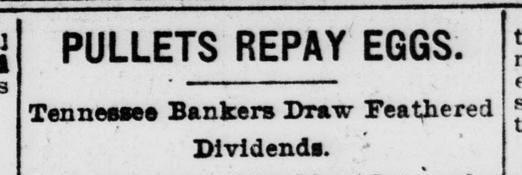
The headline on page 20 was short and sweet: "Pullets Repay Eggs." The second line was even better: "Tennessee Bankers Draw Feathered Dividends." A dividend is normally money a company shares with its owners. These bankers were paid in something that clucked.
It worked like this, under the name "pay-it-with-pullets." In the spring, the banks supplied farm youngsters with eggs from good, standard-bred chickens. The young people hatched them and raised the chicks. In the fall they returned a few grown pullets, young hens, to the bank, and kept the rest. The banks received 1,910 standard-bred pullets in all.
Why would a bank want chickens?
Not to make money on them. The bankers planned to sell the hens at auction to get local farmers interested in better poultry. Better hens lay more eggs; more eggs mean a fuller household purse; and when the farms do well, so does the bank. The children learned to raise chickens, the farmers got better birds, and the bank won loyal customers. Everybody came out ahead.
The paper set it beside another clever swap: a plan by Vermont cattle raisers to trade a bull for a bale of cotton grown by a Southern farmer. No cash needed. When people trade what they each raise best, the whole economy keeps moving.
The page 20 story
- Where: Tennessee (reported by the U.S. Department of Agriculture)
- Name of the plan: "pay-it-with-pullets"
- Spring: banks supplied youngsters with eggs
- Fall: 1,910 standard-bred pullets turned over to the bankers
- The hens: sold at auction to interest farmers in better poultry
100 years later
Similar ideas are still at work around the world. Some charities give a family a cow or a goat, and when it has young, the family passes one on to a neighbor. Instead of lending money, they lend life, and that life brings more. A tray of eggs in 1926 Tennessee was an early version of the same idea.
Sources
Dollar conversions use the U.S. Bureau of Labor Statistics CPI-U (1926 annual average 17.7; September 2026: 336.94), a factor of about 19.