Edison's City of the Future: Helicopters on the Roofs, and Mathematicians Instead of Traffic Cops
On November 15, 1926, Thomas Edison described the city of the future in an interview with Forum magazine. Rooftops would become landing fields for helicopters, mathematicians would untangle traffic, and taxes would become astonishingly low. A hundred years later, it is time to grade his answers.
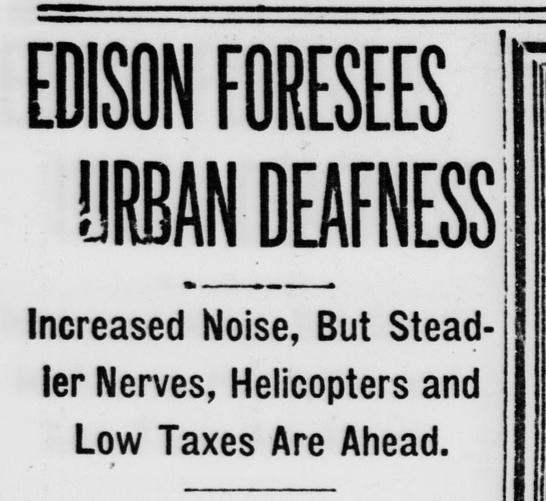
The headline on page 30 was a little odd: "Edison Foresees Urban Deafness." The real news was in the smaller line below it: "Increased Noise, But Steadier Nerves, Helicopters and Low Taxes Are Ahead." The man who gave the world the electric light and the phonograph put it bluntly: "The city of today has outgrown its usefulness." Then, one piece at a time, he sketched a scientific city of the future.
In that city, saving time would matter most. Traffic jams would be solved not by the traffic policeman but by the mathematician. Edison offered two ideas: build separate express streets and local "accommodation" streets, and sink the cross streets below the main ones so they never meet. Crime would fall once the "scientific policeman" arrived, and if cities were run by experts, taxes would become astonishingly low.
Helicopters on the roof
His boldest prediction was in the sky. The paper helpfully explained a helicopter as "the airplane that can rise vertically into the air." In 1926 there was still no practical helicopter. Once it was perfected, Edison said, the roofs of buildings, now generally unused, would be turned into landing fields. That would bring new kinds of accidents, he admitted, but people would fly anyway.
And the deafness in the headline? Cities would only get louder, Edison believed, but Nature would make people a little hard of hearing, so their nerves could stand the din. He pointed to himself. He was almost totally deaf, and he said it had given him steady nerves that even the loudest city could not jar. Only an inventor would turn a weakness into a feature.
The page 30 story
- Who: Thomas A. Edison, then 79
- Where: an interview with Edward Marshall in Forum magazine
- Traffic: mathematicians instead of traffic police; separate express and local streets; cross streets sunk below
- The sky: once the helicopter is perfected, rooftops become landing fields
- Skyscrapers: too many people entering and leaving at once would waste time, so their height should be limited
- City government: run by experts, like big business, most problems disappear and taxes drop
Grading it 100 years later
Traffic: close to a perfect score. Today computers time the traffic lights and plan our routes, and every city has expressways and underpasses. Helicopters really arrived in the 1940s, and hospitals and tall buildings now have rooftop helipads. But a city where everyone hops a helicopter from the roof? Not yet. Limiting the height of skyscrapers missed completely; they only grew taller. And astonishingly low taxes? Well, we have been waiting a hundred years.
Sources
- Evening Star, Nov. 15, 1926, page 30: "Edison Foresees Urban Deafness" (AP, New York)
- Library of Congress: "See Them from the Air!—the World Renowned Skyscrapers of Lower New York City" (Keystone View Co., 1924)
- Library of Congress: "Looking Down on New York's Skyscrapers—From Woolworth Tower" (Keystone View Co., 1916)
Dollar conversions use the U.S. Bureau of Labor Statistics CPI-U (1926 annual average 17.7; September 2026: 336.94), a factor of about 19.