"For Her Unfailing Care for My Chickens": A 73-Year-Old Remembers Every Worker in Her Will
On November 15, 1926, a warm story arrived from Cornwall, England. Mrs. Mary Hermon, who died at 73, left a goodly share of her estate to the people who had worked for her for years, and she wrote down exactly what she was thanking each of them for.
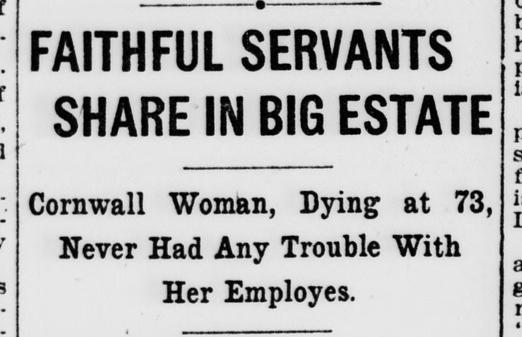
The headline on page 19 read "Faithful Servants Share in Big Estate." Mrs. Mary Hermon of Liskeard, a small town in Cornwall, lived to 73 and, it was said, never had any trouble with the people who worked in her house and on her farm. The paper put it down to her being "a close student of human nature." She did not forget them at the end.
Her will reads like a list of thank-yous. To Mary Dillon, her maid for 40 years, she left two gold brooches, a comfortable armchair and an annuity of $250 a year, about $4,750 a year today. Mrs. Hodge received a $200 annuity for her "unfailing care for my chickens," and Mrs. Bunt another $200 annuity "in appreciation of her efficient services in my dairy."
A request for whoever buys the house
The most touching part came next. Mrs. Hermon directed that her home, Doublebois, be sold, and that the buyer be persuaded to keep on "those five trustworthy, honest, loyal and industrious men" for "the remainder of their days": Mitchell the plowman, Atkins the gardener, Bunt and Hodge the farm workers, and Painter the chauffeur. The house could go, but she wanted the jobs of the people who had looked after it to stay.
She also wrote an apology. Because of "monetary losses in the war," she said, she could not leave her servants as much as she had originally intended. Even so, her estate came to $200,000, about $3.8 million today.
The page 19 story
- Where: Liskeard, Cornwall, England (AP)
- Who: Mrs. Mary Hermon, 73
- Estate: $200,000 (about $3.8 million today)
- Mary Dillon, maid for 40 years: two gold brooches, an armchair, $250 a year
- Mrs. Hodge (the chickens) and Mrs. Bunt (the dairy): $200 a year each
- Five men on the farm: the buyer to be asked to keep them for life
100 years later
Companies today work hard to be known as "a great place to work." A country lady in 1926 already knew the answer. Remember people by name, thank them for exactly what they did well, and care about their tomorrow. A gold brooch is lovely, but "for her unfailing care for my chickens" is the line that lasts.
Sources
Dollar conversions use the U.S. Bureau of Labor Statistics CPI-U (1926 annual average 17.7; September 2026: 336.94), a factor of about 19.