At 11 A.M., Washington Stopped for Two Minutes. Then Came the Bill for the War.
November 11, 1926 was the eighth Armistice Day since the end of the World War. At 11 o'clock the entire machinery of the U.S. government halted for two minutes. The same day's paper also printed the war's bill: $210 billion of lost world trade.
The Evening Star's lead story that day began: "The Nation's Capital paused from its busy work-a-day routine today." At 11 a.m. on November 11, 1918, the guns had fallen silent on the western front. This was the eighth anniversary.
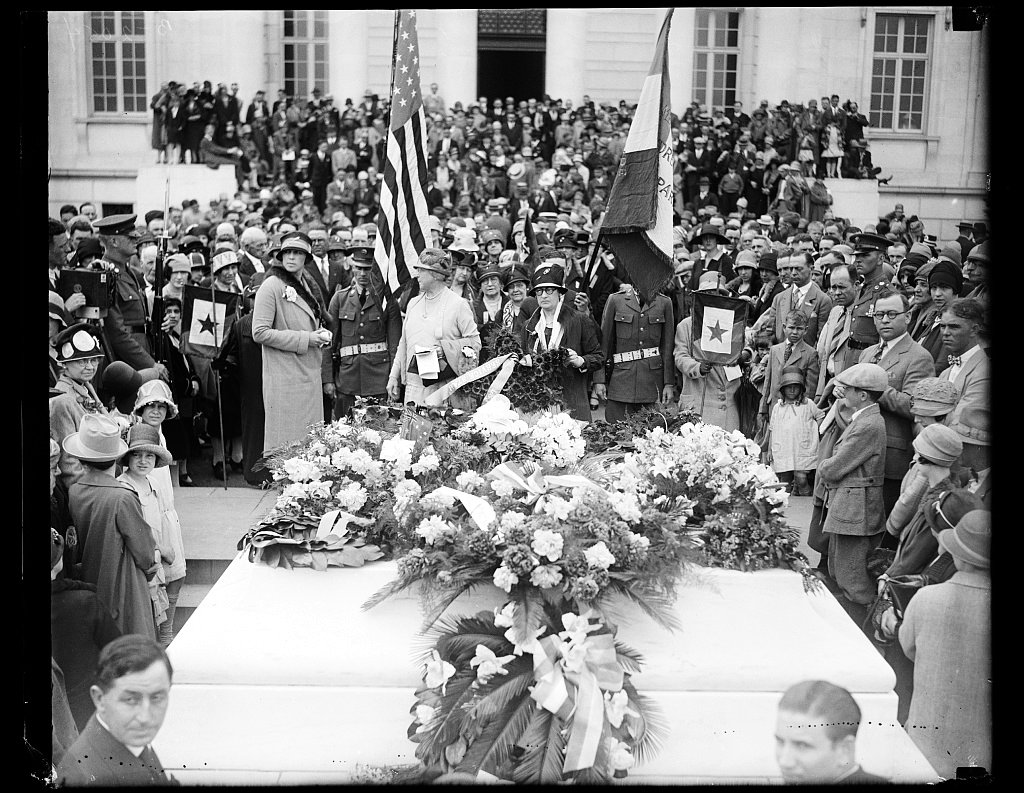
At 11 o'clock "the entire machinery of government came to a halt for a period of two minutes." At nearby Army posts the colors dipped to half-staff and the national salute of 21 guns boomed. From early morning until near sunset, little groups of men and women came and went at the Tomb of the Unknown Soldier at Arlington to lay their wreaths. President Coolidge was away in Kansas City dedicating a war memorial, but the presidential wreath lay among the others, placed there by one of his military aides, Capt. Leven C. Allen.
The mother who walked 145 miles
Page 16 carried the news from London. King George placed a wreath at the Cenotaph in Whitehall just before the two minutes of silence began at 11. But the paper said women dominated the day, "from Queen Mary to women of the humblest classes." One of them, Mrs. George Gretton of Hereford, had lost three sons. She "walked the entire 145 miles to attend."
The bill
Page 28 marked the day in numbers. The National Foreign Trade Council issued an "Armistice day accounting" based on the trade of 70 nations. Without the war, it estimated, the world would have shipped some $210 billion more in exports. World trade had only just climbed back to its 1913 level the year before. Even growing more than 10 percent a year, the council said, it would take 30 years to make up what was lost.
The map of trade had changed, too. Europe, which had sold 62 percent of the world's exports before the war, now sold 49 percent. English-speaking North America was up 40 percent, Latin North America and the West Indies 52 percent, Australia 45½ percent, and Asia most of all.
In that day's paper
- Page 1: government halts for two minutes at 11 a.m. · 21-gun salute
- Page 16: in London, a mother who lost three sons walks 145 miles
- Page 28: the war cost world trade $210 billion
- Time to catch up: 30 years
- Europe's share of world exports: 62% → 49%
100 years later
Since 1954 Americans have called the day Veterans Day, and in Britain and many other countries people still fall silent for two minutes at 11 o'clock on November 11. You can add up $210 billion. You cannot put a mother's 145-mile walk on any balance sheet.
Sources
- Evening Star, Nov. 11, 1926, page 1: "Capital Pauses to Pay Tribute to Valorous Dead"
- Evening Star, Nov. 11, 1926, page 16: "British Mothers Mark Armistice" (AP, London)
- Evening Star, Nov. 11, 1926, page 28: "War Cost Trade $210,000,000,000" (AP, New York)
- Library of Congress: Gold Star mothers at the Tomb of the Unknown Soldier (Harris & Ewing, 1927)
Dollar conversions use the U.S. Bureau of Labor Statistics CPI-U (1926 annual average 17.7; September 2026: 336.94), a factor of about 19.