The Wind Set the Price: Washington's Fish Market, 1926
Heavy nor'westers had been blowing along the Atlantic coast for days. With fewer boats bringing fish in, prices at Washington's Municipal Fish Market doubled or tripled in a week. But one favorite fish went the other way.
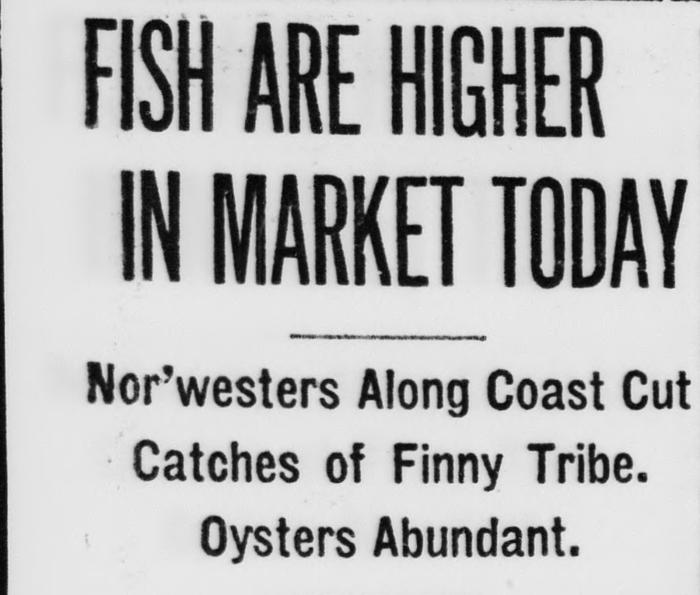
Page 13 of the Evening Star carried the market news that day. Heavy nor'westers along the Atlantic coast had cut the supply of fish at the Municipal Fish Market. Dealers had enough on hand for the retail trade, "although some prices were double those of last week."
Up, and down
Whiting and ling, 5 cents a week before, were 10 cents. Croakers went from 5 cents to 15. Rockfish from the lower Potomac were scarce at 25 and 30 cents, against 15 cents the week before. Weakfish rose from $15 to $25 a barrel.
Boston mackerel was the exception. For two or three weeks this favorite had sold at 25 cents a pound, but "immense receipts this week" knocked it down to 10 cents. Potomac catfish were plentiful too, as low as 4 cents, and jumping mullets from North Carolina "found ready sale at 15 cents."
Oysters were abundant and steady: $2 a gallon for standards, $2.25 for selects. Butter and eggs held firm. The season for fresh halibut and salmon closed November 15, so dealers were starting to offer frozen fish.
That day's prices (per pound)
- Boston mackerel: 25¢ → 10¢
- Whiting and ling: 5¢ → 10¢
- Croakers: 5¢ → 15¢
- Rockfish: 15¢ → 25–30¢
- Potomac catfish: 4¢
- Oysters: $2 a gallon ($2.25 selects)
100 years later
A storm still sends seafood prices up, and a big catch still brings them down. The fish dealer of 1926 and today's supermarket both set prices by the moods of the sea and the wind.
Sources
Dollar conversions use the U.S. Bureau of Labor Statistics CPI-U (1926 annual average 17.7; September 2026: 336.94), a factor of about 19.