The Lawless Air: In 1926, Radio Came With a Whistle
In the fall of 1926, American broadcasters were plagued by "wave pirates," stations that jumped onto other stations' frequencies. Listeners heard a whistle on practically every frequency. The broadcasters waited on Congress rather than the courts.
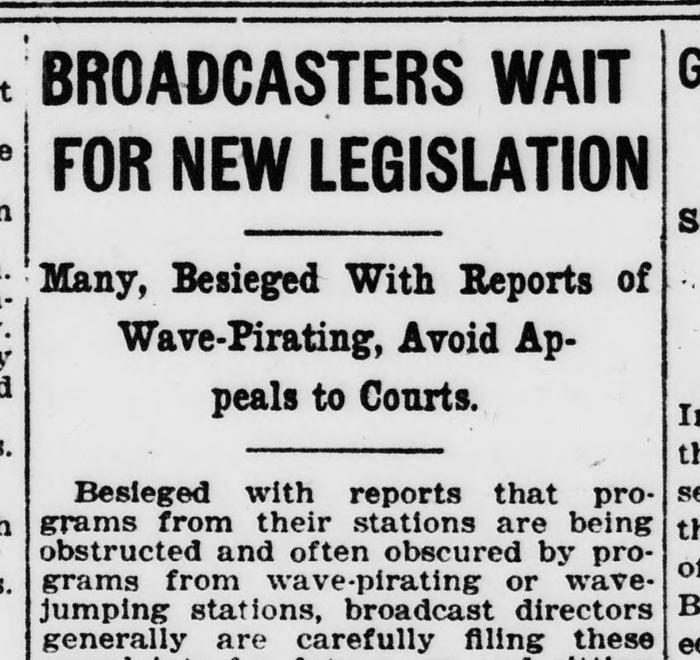
The radio page of the Evening Star, page 40, reported that broadcast directors were "besieged with reports that programs from their stations are being obstructed and often obscured by programs from wave-pirating or wave-jumping stations": stations that moved to frequencies they had no right to.
Most did not go to court. They were "carefully filing these complaints for future use and sitting tight for the present." Court action over unprecedented issues was "tedious and expensive," and there was "the slender hope" that Congress might authorize radio control before the season ended. One test was already under way in Illinois, where Chicago station WGN was seeking redress for interference with its signals.
Whistles in the night
Autumn was the season of good reception. Yet during the past few nights, the paper said, "heterodyne whistles at practically every broadcasting frequency have been reported to radio supervisors in the East." When two stations' signals overlapped, a piercing whistle was the result.
The ads on the same page show how big radio had become. General Electric advertised its Tungar charger for radio batteries: "An all night charge costs less than a dime." That many homes were tuning in every evening.
On page 40
- The problem: "wave pirates" jumping onto other frequencies
- The symptom: heterodyne whistles on practically every frequency
- Broadcasters' choice: file complaints, wait for Congress
- Case in court: station WGN, Chicago (Illinois)
100 years later
Three months later, in February 1927, Congress passed the Radio Act and created the Federal Radio Commission, which assigned each station its own frequency. Your phone and Wi-Fi don't trip over each other today thanks to that same idea: agreed rules for sharing the air.
Sources
- Evening Star, Nov. 11, 1926, page 40: "Broadcasters Wait for New Legislation"
- Wikipedia: Radio Act of 1927
Dollar conversions use the U.S. Bureau of Labor Statistics CPI-U (1926 annual average 17.7; September 2026: 336.94), a factor of about 19.