"Give the Surplus Back": President Coolidge's Plan to Cut Taxes 15%
Good news led page 1 on November 16, 1926. The Treasury had money left over, and President Coolidge wanted to hand it back to the people who paid taxes. If Congress agreed, the cut would start when income tax came due on March 15.
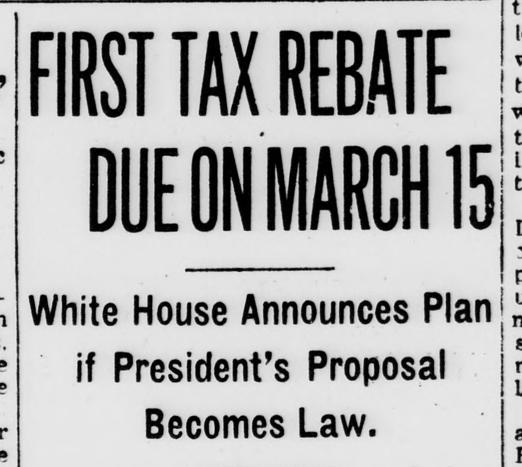
The page 1 headline read "First Tax Rebate Due on March 15." In 1926 the U.S. Treasury had money left over after paying the bills, thanks to a strong economy. President Calvin Coolidge proposed turning that surplus back to the taxpayers. If Congress passed his plan, people would pay that much less when their income tax installments came due the next March 15 and June 15.
The share kept growing. When the President first suggested it, the Treasury expected about $200 million to spare, enough for a 10 percent allowance. Then Secretary Andrew Mellon found $50 million more, and the figure became 12½ percent. Now another $50 million had come into view, the surplus estimate stood at $300 million, about $5.7 billion today, and 15 percent could be "lopped off the levies." On the first two quarterly installments alone, that would mean a 30 percent reduction.
"A tax reduction, pure and simple"
The public was confused. Papers had been tossing around rebates, refunds and credits. The President, through his spokesman, cleared it up: whatever you call it, it is "a tax reduction, pure and simple." But he did not want to rewrite the tax law permanently. A surplus this year was no promise of one next year or the year after. Give it back when there is extra, and stay ready for the lean years.
The page 1 and page 7 story
- Announced by: the White House, President Coolidge
- Expected surplus: $300,000,000 (about $5.7 billion today)
- Share returned: 10% at first → 12½% → 15%
- When: the March 15 and June 15 income tax installments
- The catch: Congress had to approve
100 years later
Governments still send money back now and then, through rebates, relief checks and refunds at tax time. And a hundred years on, "there was money left over, so you get some back" is still the happiest kind of tax news a household can read.
Sources
- Evening Star, Nov. 16, 1926, page 1: "First Tax Rebate Due on March 15"
- Evening Star, Nov. 16, 1926, page 7: continuation of the story
Dollar conversions use the U.S. Bureau of Labor Statistics CPI-U (1926 annual average 17.7; September 2026: 336.94), a factor of about 19.