A Year's Ledger for the Shortcut Between Two Oceans: Panama Canal Tolls Up $1.5 Million
On November 16, 1926, the paper reported the Panama Canal governor's annual report. In the past fiscal year 5,197 ships paid tolls totaling $22,931,055: 524 more ships and over $1.5 million more than the year before.
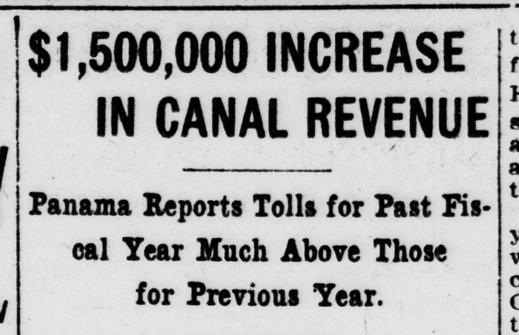
The headline on page 10 read "$1,500,000 Increase in Canal Revenue." The Panama Canal is the shortcut between the Atlantic and the Pacific. Without it, ships had to sail all the way around the tip of South America, so they gladly paid to pass. Gov. Walker's report counted 5,197 toll-paying vessels in the past year, an average of about $4,400 each, or roughly $84,000 in today's money.
The combined net revenue of the canal's businesses was $17,340,865, up from $15,573,751 in 1925. Cargo through the canal grew by more than 2 million long tons. American ships carried about 53 percent of the tonnage, followed by British ships at 26 percent, Norwegian at 4 and German at 3½.
Fewer tankers, more cargo ships
There is a twist. Commercial traffic was up, but the all-time record still belonged to 1924, a year when tankers hauling California oil east crowded the canal. Meanwhile passenger ships and general cargo carriers grew steadily: leaving tankers out, their net tonnage rose from 13.2 million tons in 1924 to 18.5 million in 1926. The oil boom had passed, but the everyday trade in people and goods kept growing every year.
The page 10 story
- Source: annual report of Gov. Walker of the Panama Canal
- Tolls: $22,931,055 (up more than $1,500,000)
- Ships: 5,197 (524 more)
- Net revenue: $17,340,865 (vs. $15,573,751)
- By flag: U.S. 53%, British 26%, Norwegian 4%, German 3½%
100 years later
The Panama Canal is still one of the great shortcuts of world trade. Panama has run it since 1999, and in 2016 new, larger locks opened for bigger ships. Today a single large ship can pay hundreds of thousands of dollars to cross. As that 1926 ledger showed, a shorter road attracts money.
Sources
Dollar conversions use the U.S. Bureau of Labor Statistics CPI-U (1926 annual average 17.7; September 2026: 336.94), a factor of about 19.