"The Sea Is an Unlimited Source of Power": A French Scientist Makes Energy From Warm and Cold Water
On November 16, 1926, word came from Paris that French scientist Georges Claude had shown the Academy of Science a generator that makes power from the sea, using the difference in temperature between warm tropical surface water and the cold water far below.
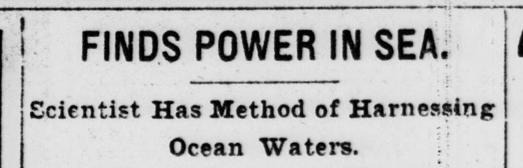
The headline on page 25 read "Finds Power in Sea." "The sea is an unlimited source of motor power, which can be obtained at a minimum cost," Prof. Georges Claude told the Academy of Science, and he demonstrated a generator he had built. The paper introduced him as the inventor of a way to make synthetic ammonia. He is also the man who gave the world the neon sign.
The idea is simple. The surface water of tropical seas is always lukewarm, while the deep water is always very cold. Claude and his colleague Prof. Boucherot planned to run machines on that difference. No coal, no oil, and an ocean without end.
Building with stones nobody wanted
The same day, page 35 carried another French story about finding a use for what was thrown away. Pyramids of mine refuse once marked the French coal fields. Now that rock, brought up with the coal, was being turned into concrete bricks, and the piles were disappearing. Walls around the mine pits, miners' cottages, factories and warehouses were all being built from it. Useless stone had become homes.
The page 25 and 35 stories
- Announced by: Georges Claude, Academy of Science, Paris (AP)
- How: the temperature difference between warm surface water and cold deep water in tropical seas
- Claude: inventor of the neon sign and a synthetic ammonia process
- Page 35: French mine refuse made into concrete bricks for homes and factories
100 years later
A few years later Claude actually ran such a plant in the sea off Cuba and produced electricity. The method is now called ocean thermal energy conversion, or OTEC, and small plants in Hawaii and near Okinawa, Japan, keep developing it. As the world looks for clean power, a scientist's century-old dream is getting a second look.
Sources
- Evening Star, Nov. 16, 1926, page 25: "Finds Power in Sea" (AP, Paris)
- Evening Star, Nov. 16, 1926, page 35: "Mine Refuse Is Useful" (AP, Barlin, France)
Dollar conversions use the U.S. Bureau of Labor Statistics CPI-U (1926 annual average 17.7; September 2026: 336.94), a factor of about 19.