At 2:30 P.M., the World's Fastest Seaplanes Raced Over the Sea
On the afternoon of November 13, 1926, the Schneider international seaplane race was flown at Hampton Roads, Virginia. Six planes lined up: three for the U.S. Navy and three for Italy.
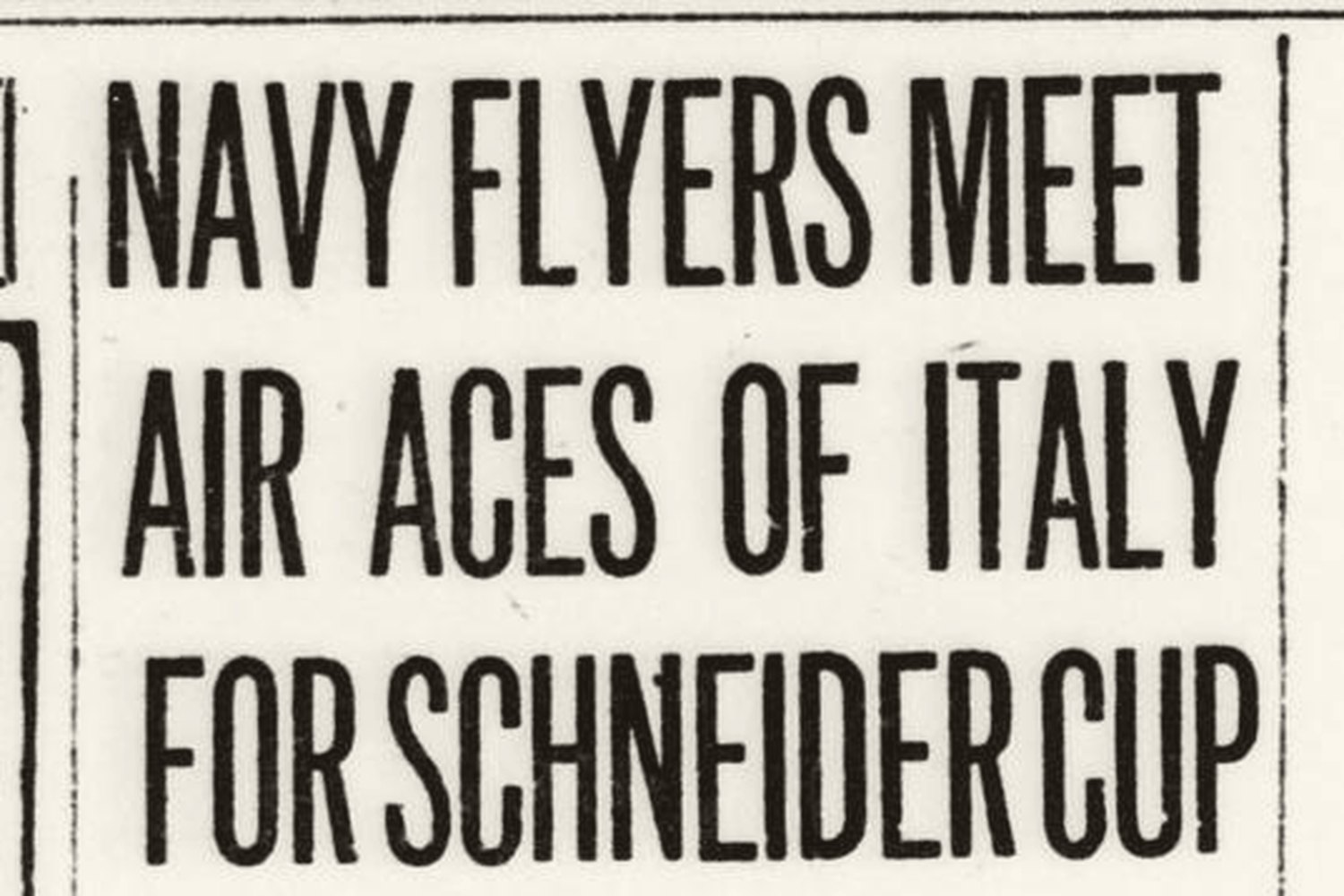
The Evening Star's front page that day led with "Navy Flyers Meet Air Aces of Italy for Schneider Cup." The Schneider Trophy was an international speed race for seaplanes, planes that take off from and land on water. In the 1920s it was the Olympics of aircraft design.
The starter's gun was set for 2:30. Three U.S. Navy planes and three Italian planes lined up. The Americans had lost one of their racers in a crash the day before, so "an ordinary Navy single-seat fighting ship" filled the gap. Still, the paper wrote, the race would give "education and entertainment" to the crowd and "wider information" to the aircraft industry.
A plane with one wing taken off
All eyes were on Italy's three Macchi racers. "To the layman," the reporter wrote, "it appears that the Italians took a model of one of America's Curtiss racers, lifted off the top wing, threw it away." They were monoplanes, with a single wing instead of two, and the paper said the contest "may decide fate of monoplanes." Each carried a compact Fiat engine of 800 horsepower, almost 200 more than the Americans'.
The pilots drew praise too. Capt. Arturo Ferrarin landed twice on the bay at 100 miles an hour; the paper called his landings "of the finest ever seen."
On the front page
- Place: U.S. air station, Hampton Roads, Virginia
- Start: 2:30 p.m.
- Entries: 6 planes (U.S. 3, Italy 3)
- Italy: Macchi monoplanes with 800-hp Fiat engines
- The big question: one wing or two?
100 years later
Italy's Mario de Bernardi won that afternoon. And, as the paper guessed, the future of the sky belonged to the monoplane. Every airliner we fly today has one wing on each side, not two stacked. One race helped change the shape of the airplane.
Sources
- Evening Star, Nov. 13, 1926, page 1: "Navy Flyers Meet Air Aces of Italy for Schneider Cup"
- Wikipedia: 1926 Schneider Trophy
Dollar conversions use the U.S. Bureau of Labor Statistics CPI-U (1926 annual average 17.7; September 2026: 336.94), a factor of about 19.